
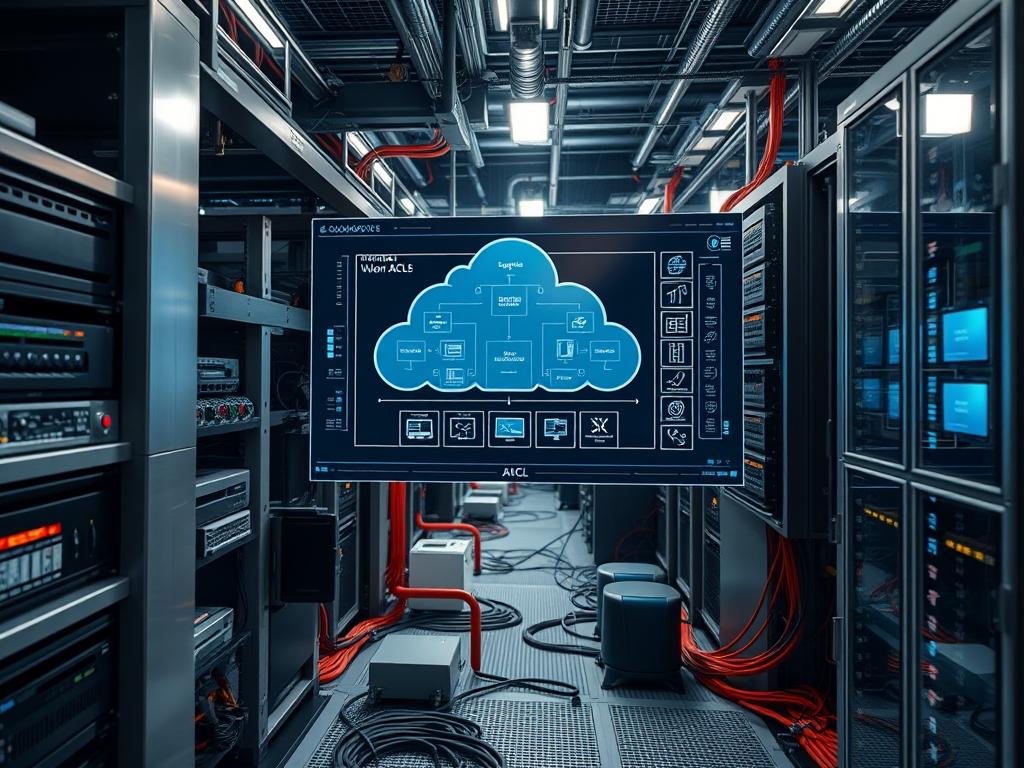
CloudStack Network ACLs function as the primary ingress and egress gateway filter within a Virtual Private Cloud (VPC) environment. In the modern data center, whether managing energy grids, water treatment facilities, or high-density network clusters, the “Problem” is the risk of lateral movement and broad attack surfaces in flat network topologies. The “Solution” provided by CloudStack involves the implementation of segmented VPC tiers, each controlled by a discrete set of Access Control Lists. These ACLs provide a stateless or stateful security layer (depending on the hypervisor and VR configuration) that dictates how the Virtual Router (VR) handles traffic at the tier boundary. By leveraging ACLs, architects can ensure that sensitive payloads are only accessible to authorized internal services; thereby reducing unnecessary overhead and minimizing the risk of packet-loss during high-concurrency events. This manual provides the technical framework for designing and auditing these critical security assets.
Technical Specifications
| Requirement | Default Range/Value | Protocol/Standard | Impact Level | Recommended Resources |
| :— | :— | :— | :— | :— |
| API Version | 4.11.x to 4.20.x | REST / JSON | 10 (Critical) | Management Server: 8GB RAM |
| CIDR Support | /0 to /32 | IPv4 / CIDR | 9 (High) | VR: 1 vCPU, 512MB RAM |
| Protocol Support | 1-255 | TCP, UDP, ICMP | 10 (Critical) | Physical NIC: 10GbE |
| Port Range | 1-65535 | IEEE 802.1Q | 8 (Moderate) | MTU: 1500 or 9000 (Jumbo) |
| Rule Limit | 100 per Tier | ITPables / NFTables | 7 (Medium) | VR Storage: 2GB Target |
Configuration Protocol
Environment Prerequisites:
Successful deployment of CloudStack Network ACLs requires a functional VPC infrastructure sitting atop an authorized hypervisor like KVM, XenServer, or VMware ESXi. The management layer must run CloudStack 4.15 or higher to support advanced ACL features. Secure Shell (SSH) access to the Management Server and the Virtual Router is mandatory for low-level auditing. The environment must adhere to IEEE 802.1Q for VLAN tagging; ensuring that encapsulation remains consistent across the physical switch fabric. Users must possess “Root” or “Domain Admin” permissions to modify VPC-level networking.
Section A: Implementation Logic:
The engineering design of CloudStack Network ACLs is built on the principle of sequential evaluation. Each ACL rule is assigned a priority number; the Virtual Router processes these rules from the lowest number to the highest. Once a packet matches a rule, the action (Allow or Deny) is immediately taken, and no further rules in the list are evaluated. This logic makes the setup idempotent; multiple applications of the same rule set will result in the same system state without introducing side effects. Effective design requires placing high-traffic rules (those with the highest hit count) at the top of the list to reduce CPU overhead and minimize latency within the packet-processing engine.
Step-By-Step Execution
1. Create the ACL Container:
To begin, the administrator must define a named ACL container within the VPC. This is an administrative grouping that will eventually hold individual rules.
cloudstack-api createNetworkACL vpcId=
System Note: This command initializes a new database entry in the cloud.network_acl table; allocating a unique identifier that the VR uses to map rule sets to specific tier interfaces.
2. Define the Ingress Rule Logic:
Individual rules must be added to the container to permit or deny specific traffic. For example, allowing TCP traffic on port 443 for web services.
cloudstack-api createNetworkACLItem aclId=
System Note: The CloudStack Management Server sends a JSON manifest to the cloud-agent on the physical host; which then executes a series of iptables or nftables commands within the Virtual Router’s network namespace to update the kernel-level filtering table.
3. Implement Egress Restrictions:
Egress rules are critical for preventing data exfiltration. Restrict outbound traffic to known update repositories or internal logging servers.
cloudstack-api createNetworkACLItem aclId=
System Note: This modifies the FORWARD chain within the VR’s kernel; ensuring that the payload of outgoing packets is dropped unless it matches the designated destination CIDR.
4. Associate the ACL with a VPC Tier:
An ACL is dormant until it is associated with a specific VPC tier (subnet).
cloudstack-api replaceNetworkACLList aclId=
System Note: This triggers a re-synchronization of the network state. The VR restarts the dnsmasq and haproxy services if necessary to ensure that the new filtering logic does not conflict with existing load-balancing or DHCP services.
5. Verify Rule Persistence:
The administrator must verify that the rules are active on the Virtual Router by logging in via SSH and inspecting the firewall state.
ssh -i /path/to/key root@
System Note: This command queries the netfilter framework directly from the Linux kernel; providing a real-time count of packet matches and byte throughput for each ACL entry.
Section B: Dependency Fault-Lines:
A frequent point of failure in CloudStack environments is the “Split-Brain” scenario in redundant Virtual Routers. If the VR pair loses synchronization over the heartbeat link, both units may attempt to manage the ACL state; leading to inconsistent rule enforcement and signal-attenuation between the management server and the data plane. Another common bottleneck is the exhaustion of the VR’s connection tracking table (conntrack). Under high concurrency, the VR may run out of memory to track stateful sessions; resulting in random packet-loss even if the ACL rules are technically correct. Finally, ensure that the physical host’s thermal-inertia is managed; if CPUs throttle due to heat, the latency of packet inspection within the ACL chain will increase exponentially.
THE TROUBLESHOOTING MATRIX
Section C: Logs & Debugging:
When an ACL fails to apply, the first diagnostic step is checking the Management Server log located at /var/log/cloudstack/management/management-server.log. Search for “NetworkACL” strings to find transition errors. If the management layer reports success but traffic is still blocked, move to the Virtual Router and inspect /var/log/cloud.log and /var/log/router.log.
Common error strings include “Failed to apply network rules” which often indicates a syntax error in the underlying iptables script or a full disk partition on the VR. To debug packet-level issues, use tcpdump -i any ‘port 443’ on the VR to observe if packets reach the interface or are dropped by the kernel before processing. For ICMP issues, monitor for “Destination Unreachable” codes; which can indicate that a “Deny” rule is trigger-happy or that a routing loop has formed during the ACL update.
OPTIMIZATION & HARDENING
Performance Tuning:
To maximize throughput, minimize the number of rules per ACL. Use contiguous CIDR blocks (e.g., 10.0.0.0/22 instead of four /24s) to reduce the number of comparisons the CPU must perform. In environments with high concurrency, increase the net.nf_conntrack_max value via sysctl on the VR to prevent table overflows. This ensures that the overhead of stateful inspection does not degrade the overall network speed.
Security Hardening:
Following the principle of least privilege, every ACL should end with a “Deny All” rule (though CloudStack often applies an implicit deny at the VPC level). Regularly audit rule sets using the cloudstack-api listNetworkACLItems command to identify “Shadow Rules” that are never hit. Disable any protocol not explicitly required for the application; including legacy protocols that might be vulnerable to fragmentation attacks.
Scaling Logic:
As the infrastructure expands, use Global ACLs to apply consistent security policies across multiple VPCs. Under high traffic loads, consider upgrading the VR service offering to a larger instance type (e.g., more vCPUs) to handle the increased logic requirements of complex ACL chains. This prevents the VR from becoming a bottleneck as the encapsulation overhead increases with larger volumes of VXLAN or VLAN traffic.
THE ADMIN DESK
How do I revert a broken ACL quickly?
Use the replaceNetworkACLList command to switch the tier back to the “default_allow” or “default_deny” ACL. This is an idempotent action that restores connectivity within seconds by purging the existing iptables chain on the VR.
Why are my Egress rules being ignored?
Check if the VPC has “Consolidated Egress” enabled. If egress is set to “Allow” by default at the VPC level, you must manually add a high-priority “Deny” rule. Always verify the trafficType variable is set to “Egress” in the API.
Can I modify a rule’s priority after creation?
No; CloudStack does not allow direct editing of a rule’s number. You must delete the rule using deleteNetworkACLItem and recreate it with the correct number to ensure the logic remains in the intended sequential order.
What causes “Failed to apply rules” in the UI?
This is usually caused by the Virtual Router being in a “Starting” or “Error” state. Check the cloud.vm_instance table in the database or use the UI to ensure the VR is “Running” before pushing ACL updates.
Does changing an ACL break existing connections?
CloudStack ACLs are generally stateful on most hypervisors. Changing a rule will not drop existing established connections unless the VR is forced to restart or the connection times out and attempts to re-initiate through the updated rule set.